
As we look towards the 2027 National General Election, a new report from the National Research Institute (NRI) has highlighted some really important issues. It’s about how our country is divided up for elections – what we call electoral boundaries – and whether these divisions are fair and follow the law.
It’s a big deal for how democracy works here, especially in our increasingly connected digital world.
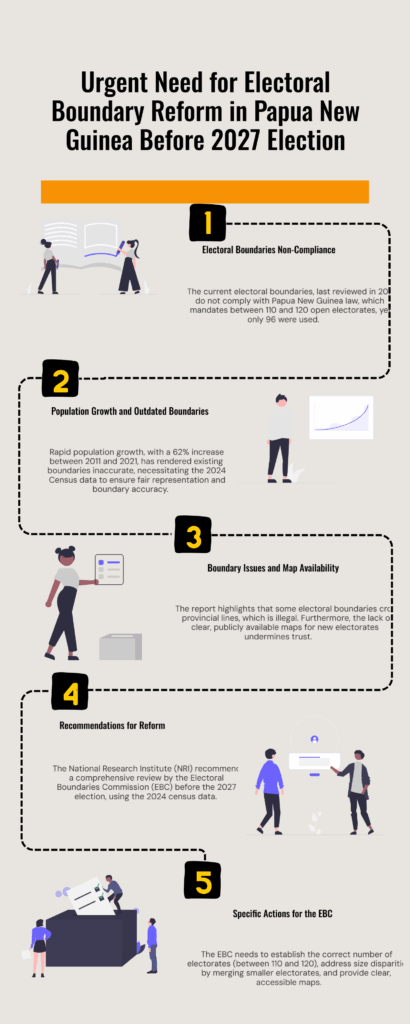
The main problem the NRI found is pretty straightforward: the way our election areas were last reviewed in 2021 doesn’t follow our own laws. Papua New Guinea’s law says we should have between 110 and 120 open electorates. But the 2021 review used only 96.
That’s a significant difference.
When there are fewer electorates than the law allows, it can mean that some areas have far more people in them than others. This makes it harder for everyone’s voice to be heard equally, which isn’t fair representation. Online, this kind of legal gap can quickly lead to worries and discussions about fairness, affecting how much people trust the election process.
Think about how much PNG has changed.
Our population grew a huge amount, from about 7.3 million people in 2011 to an estimated 11.8 million in 2021. That’s a massive 62 per cent jump in just ten years. At least five million more Papua New Guineans were born during that period.
When election boundaries were last truly set, they were based on much older numbers. So, our current boundaries just don’t match where all the people live now. For example, the report states the annual population growth rate is 6.205 percent, meaning the country’s population is projected to double every 11.25 years.
This rapid growth makes it even more important to have up-to-date information.
For PNG to understand what’s happening and plan for the future, we need the 2024 Census data and we’re still waiting for Richard Masere and the census team to deliver. (K17 million on tablets IS a lot of money, just saying). Because we need the newest numbers to make sure election information is accurate and reflects where people truly live.
The problems don’t stop there.
The NRI report also points out that some election boundaries actually cross provincial lines. For example, parts of Komo/Hulia in Hela Province and Nipa/Kutubu in Southern Highlands Province share certain local government areas. This isn’t allowed by law and can be very confusing for communities. Also, for new electorates that are supposed to start in 2027, like Motu-Koita or Baniara, clear maps haven’t been made public yet. In our digital world, where we expect to find maps and information easily on our phones or computers, this lack of clear, public maps can really hurt trust and make it hard for people to know exactly where they belong in an election.
So, what should happen next? The NRI isn’t just highlighting problems; they’re offering practical solutions. They strongly recommend that the Electoral Boundaries Commission (EBC) carries out a full review of all boundaries before the 2027 election. This review must use the fresh 2024 census data.
Here’s what they say needs to be done:
- Get the Numbers Right: The EBC needs to set the correct number of electorates, making sure it’s between 110 and 120, as the law requires. Using 96 electorates in the 2021 review was simply not accurate.
- Fairer Sizes: When reviewing boundaries, the EBC shouldn’t just look at making big electorates smaller. They also need to look at smaller electorates and consider merging them with neighbours to make sizes fairer. For example, Obura Wonera District has been very small since 1972.
- Clear Maps for Everyone: The EBC must have clear maps for all recommended electorates before they are put into use. They should work with local leaders to make sure these maps make sense for communities, culture, and land, and avoid any shared boundaries between electorates or provinces.
In our digital age, these steps become even more important. Using digital mapping tools (like what you see on many websites) can help draw accurate boundaries. Putting these maps online in an easy-to-understand way, and even asking for public feedback through digital channels, can make the whole process much more open and fair.
As PNG moves towards the 2027 election, making sure our electoral boundaries are fair, clear, and legal is a big test of our commitment to democracy. It’s about ensuring every person’s vote genuinely counts, both on paper and in the digital conversations shaping our nation.