
Papua New Guinea’s 2026 National Budget lands at a moment in the country’s political cycle — one year out from the next national elections and in the middle of an escalating law-and-order crisis that has tested the capacity of the state.
With total spending reaching K30.9 billion, the Marape–Rosso Government has delivered a budget that leans heavily toward security, policing, courts, and national stability, while offering modest but important gains in health and education.
Framed under the theme “Security with Growth,” the 2026 Budget is structurally different from the one tabled last year. While overall expenditure has increased, the shape of the spending tells a sharper story about the Government’s priorities — and the pressures it faces.
Strong Push for Law and Justice
The most dramatic movement is in the Law and Justice Sector, which receives a K219.5 million increase, or 9.6 per cent more than in 2025. This shift represents the clearest signal yet that the government is preparing for the 2027 elections while responding to public anxiety over violent crime, tribal conflict, and the weakening presence of state agencies in rural districts.
At the centre of the sector is the Royal Papua New Guinea Constabulary, allocated about K581 million in 2026. The funding covers ongoing recruitment, expanded provincial commands, police housing, uniforms, logistics, and the maintenance of essential services such as rations and transport. Specialised policing units — including counter-terrorism and investigative teams — also see increases, underscoring the government’s concern about emerging national security risks.
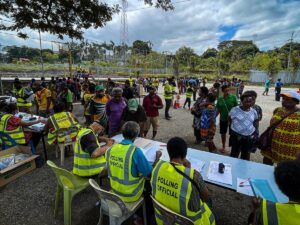
The Electoral Commission is another major beneficiary. With less than two years before Papua New Guineans head back to the polls, the Commission receives K50 million in 2026 to begin preparations, including training, early procurement of materials, and improvements to the electoral roll. An additional K12 million comes through a development partner–supported elections project. Together, these allocations mark one of the largest pre-election administrative investments in recent budget history.
Defence Spending Continues to Rise in 2026
The PNG Defence Force receives K413 million, including a significant rise in goods and services. One of the most notable increases is in catering, which jumps to nearly K74 million — reflecting ongoing pressures in sustaining military operations across multiple provinces. A further K30 million is directed toward defence infrastructure, including barracks upgrades and new facilities required under long-term national security planning.
Health and Education Grow, But Not as Quickly
Beyond security, the Government has increased allocations for health and education, though not at the same pace.
Health rises by K436 million, driven by higher costs in medicines, hospital services, and provincial health authorities. Education receives K609 million in capital investment, continuing the multi-year infrastructure drive across universities and secondary schools.
However, critics note that while these increases are welcome, they are largely absorbed by inflation, population growth, and persistent structural challenges like workforce shortages and ageing facilities.
Sectors That Miss Out
Some sectors see relatively little movement.
The Community and Culture Sector, responsible for youth programs, arts, heritage and social development initiatives, receives only K332 million — roughly 1 per cent of the total budget.
Similarly, the Utilities Sector receives around 2 per cent, despite longstanding concerns about electricity reliability, water supply, and service expansion.
The economic sector — agriculture, SMEs, and industry — receives modest capital funding compared to security and infrastructure, raising questions about whether the country can diversify fast enough to reduce its dependence on resource revenues.
The 2026 Budget makes one thing clear: the Government is betting that stability, law enforcement, and secure elections form the foundation for economic growth. Whether that strategy pays off will depend on implementation — long the Achilles’ heel of national budgets.
For now, the spending plan reflects a government trying to secure the state, reassure the public, and prepare for the country’s most logistically complex democratic event: the national elections.