Goroka never saw combat during World War II, but the war reached it all the same.
High in the Eastern Highlands, the valley had long been shaped by gardens, exchange and seasonal rhythms rather than military strategy. That changed abruptly in the early 1940s. As Japanese forces advanced along Papua New Guinea’s northern coastline, Australia’s assumptions about distance, defence and geography collapsed. The interior — once considered remote and marginal — became strategically indispensable.
“The Second World War disturbed both the physical and conceptual dimensions of Australian rule in Papua New Guinea.”
— Stuart Doran, editor, Australia and Papua New Guinea 1966–1969
What had once been peripheral was suddenly central. Inland locations, shielded by mountains and distance, offered safety from bombing and ground attack. Goroka’s elevation and broad valley made it an ideal candidate for a role it had never been intended to play.
An Airstrip Cut into the Highlands
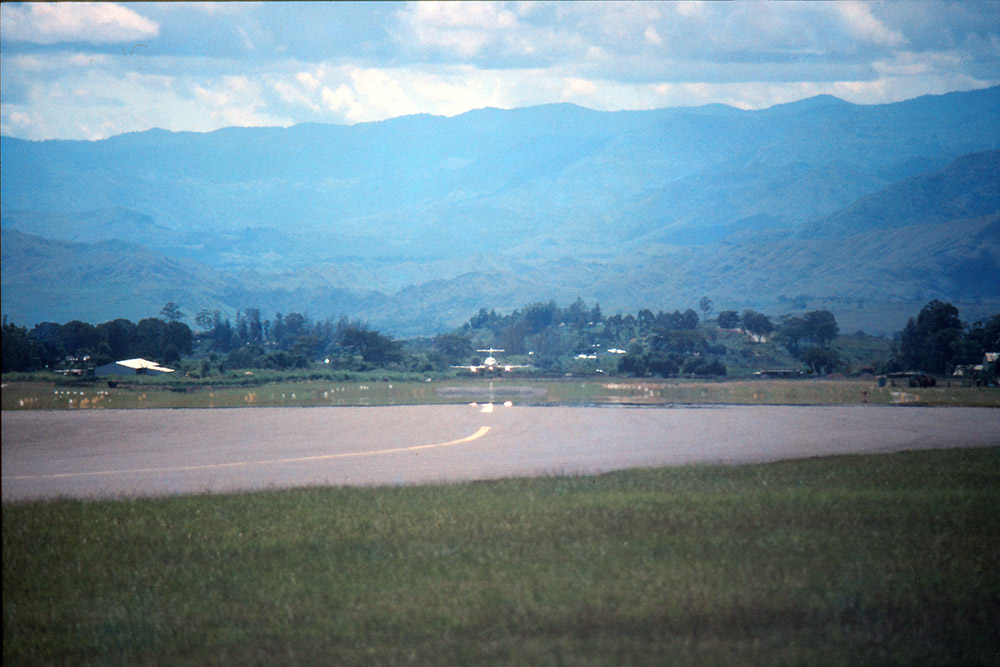
That strategic shift took physical form in Goroka. Engineers cleared an airstrip into the valley floor, cutting into land that had sustained subsistence life for generations. It was not designed as a permanent installation. It was built to function, and to function immediately.
Aircraft arrived carrying troops, fuel and equipment, and departed with the wounded evacuated from battles unfolding along the Kokoda Track and the northern coast. Goroka became a place of transition — a logistical hinge in a campaign defined by terrain and distance. There was no bombing here, no ground fighting, but the presence of the war was unmistakable.
“On 29 June 1943 the airfield was expanded for military use by U.S. Army engineers, supervised by Australian Army units. With the help of more than 1,000 native labourers, the runway and dispersal bays were made operational in just seven days.”
— Pacific Wrecks, Goroka Airfield (WWII history)
That speed mattered. Inland airfields like Goroka were built under pressure, designed to keep aircraft moving and supply lines intact while coastal bases remained under threat. The Highlands, once imagined as a buffer zone, became a backbone — a secure interior that allowed the war effort to continue.
Remembering a Quiet War
When the fighting ended in 1945, the airstrip remained. Unlike many temporary wartime installations, Goroka’s runway evolved into lasting infrastructure. Aircraft continued to land, carrying patrol officers, administrators, missionaries and traders. What had been built for military necessity became the foundation of post-war expansion.
Much of that history is now preserved at the J.K. McCarthy Museum in Goroka. Among its collections are World War II relics — fragments of aircraft, weapons, tools and military equipment — that ground the scale of the global conflict in tangible objects. Named after patrol officer and aviator J.K. McCarthy, the museum places the war alongside stories of first contact and post-war administration.
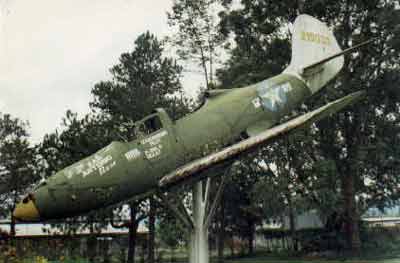
Much of that history is now preserved at the J.K. McCarthy Museum in Goroka. Among its collections are World War II relics — fragments of aircraft, weapons, tools and military equipment — that ground the scale of the global conflict in tangible objects. Named after patrol officer and aviator J.K. McCarthy, the museum places the war alongside stories of first contact and post-war administration. The exhibits do not speak of battles fought here, but of a town drawn into war through logistics, movement and necessity.
In the decades that followed, roads linked Goroka to the coast, coffee tied surrounding valleys to global markets, and the town emerged as a permanent administrative and commercial centre of the Eastern Highlands. But its trajectory was set during the war years, when strategic necessity turned a Highlands valley into a gateway.
Today, planes still descend into the same bowl of land first cleared under wartime urgency. The cargo has changed — students, farmers, officials, families — but the purpose remains familiar: connection. Goroka’s significance in World War II lies not in battle, but in support — a reminder that wars are sustained not only at the front, but in the quiet inland places that make everything else possible.