
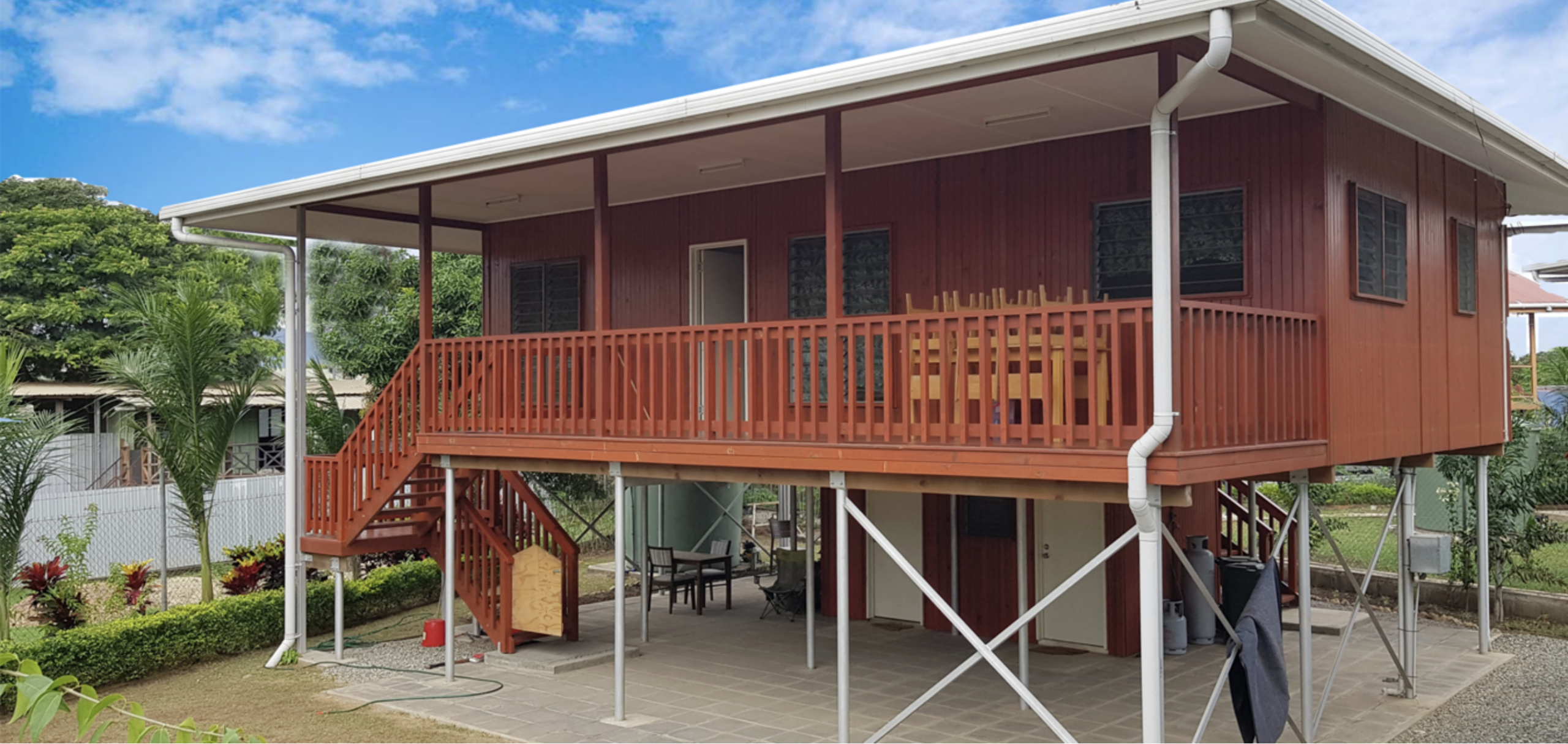
Housing has become one of Papua New Guinea’s most urgent social and economic challenges. In towns and cities, rents continue to rise faster than wages, land remains difficult to access, and many families find themselves locked out of formal home ownership altogether. Yet despite these challenges, low-cost housing options do exist — if people know where to look and how to approach them.
The idea that a house must be a fully finished, high-spec structure from day one is part of the problem. For most Papua New Guineans, affordability will come not from perfection, but from starting small and building over time.
Portable and Modular Homes
One of the fastest-growing low-cost housing options in PNG is the use of portable or modular homes. These are factory-built units, often steel-framed, that can be transported to site and installed quickly.
Basic models can cost significantly less than traditional block or timber houses. Entry-level units may start as open-plan shells, with owners adding kitchens, bathrooms, or extra rooms later as finances allow. This “core house” approach reduces upfront costs and allows families to enter the housing ladder sooner rather than waiting years to afford a full build.
Portable homes also suit government housing programs, disaster resettlement, and employer-assisted housing because they are scalable and predictable in cost.
Incremental Housing: Build as You Can Afford
Incremental housing is not new in PNG — it has simply not been formally recognised. Many families already build in stages: one room first, then another, then proper roofing or internal walls.
What has changed is that newer products and clearer land and title systems allow incremental building to happen more safely and formally. A household might start with a one-room or one-bedroom structure, connect basic services, and then expand when income improves.
The advantage is psychological as well as financial. People stop paying rent and begin investing in something they own, even if it starts modestly.
Strata Title and Smaller Units
Recent reforms to strata title laws open up new low-cost housing possibilities, especially in urban areas where land is scarce. Strata titles allow individual units within a larger development — such as townhouses or small apartments — to have their own legal title.
This matters because banks are far more willing to lend when there is a clear, registered title. Smaller strata units mean smaller loan sizes, which translate to lower monthly repayments. For first-time buyers, this can be the difference between qualifying for a loan or not.
Strata housing works best when developments are designed for affordability, with modest finishes and carefully controlled body corporate fees.
Niu Homes: Kit Housing Made in PNG
Niu Homes has emerged as one of the most recognisable players in PNG’s affordable housing space. Their model is based on kit homes manufactured using locally grown plantation pine, engineered and treated to meet PNG and Australian building standards.
Niu Homes products range from very small starter units to larger family homes, allowing buyers to choose based on budget and expand later.
Because the homes are pre-designed and prefabricated, construction timelines are shorter and costs are more predictable than traditional builds.
For low- and middle-income earners, Niu Homes work best when paired with incremental financing — building the basic structure first, then upgrading finishes over time. Their use of local materials also supports domestic industry while helping manage costs.
Strato Homes and Steel-Based Solutions
Strato Homes represents a newer generation of steel-framed and modular housing solutions aimed at speed, durability, and affordability. Steel-based homes are particularly attractive in PNG’s climate because of their resistance to termites and reduced long-term maintenance.
Strato-style housing products are well suited to urban and peri-urban areas where land sizes are smaller and fast delivery is important. Like other modular systems, they allow buyers to start with a compact, functional unit and expand later as income improves. For low-cost housing programs, steel modular homes are especially useful for worker accommodation, settlement upgrading, and strata-style developments where uniformity and durability matter.
Home Loans and Superannuation Support
Traditional home loans in PNG often require deposits that are beyond the reach of low-income earners. However, some pathways can help bridge the gap.
Superannuation housing advances allow eligible members to access part of their retirement savings for housing. While not suitable for everyone, this can provide a crucial deposit or help fund a basic structure.
Some banks also offer first-home or owner-occupier loans with longer terms, spreading repayments over 25 to 30 years. When combined with a smaller, lower-cost dwelling, these loans become more manageable.
Community and Employer-Led Solutions
Low-cost housing does not have to be an individual struggle. Employer-assisted housing — particularly for teachers, nurses, police and essential workers — can pool risk and reduce costs. Community savings groups can also help households build deposits collectively.
These approaches work best when linked to genuinely affordable housing products rather than high-end developments.
Rethinking What “Affordable” Means
Low-cost housing in PNG will not come from copying overseas suburbs or luxury apartments. It will come from simple, durable designs, smaller footprints, flexible financing, and acceptance that housing is a journey, not a one-time purchase.
The real opportunity lies in combining portable housing, incremental building, strata titles, and smarter financing into a system that meets people where they are — not where planners wish they were.
Affordable housing is possible. But only if affordability is treated as the starting point, not an afterthought.





Good idea I’m really interested in purchasing this
Affordability is the big issue to start with. Expandable Kit Home Concept is the Way To Go. Financial Institutions Financing Packages be reasonable for the starters, otherwise.
Awesome piece..
I’m interested in securing a home as a working public servant.
And I would love having more detail information and the requirements to own or purchase a home.
Who can I contact?
Good sale apporterble for PNG hard working people.
Interesting News!.
I am interested would appreciate it if you could provide more detailed information on the products and the process how we should take to purchase…