The latest interest crediting rate announcement from Comrade Trustee Services Limited (CTSL) signals more than just a strong year for the fund—it reflects a broader shift from recovery to stability, and now, measured growth.
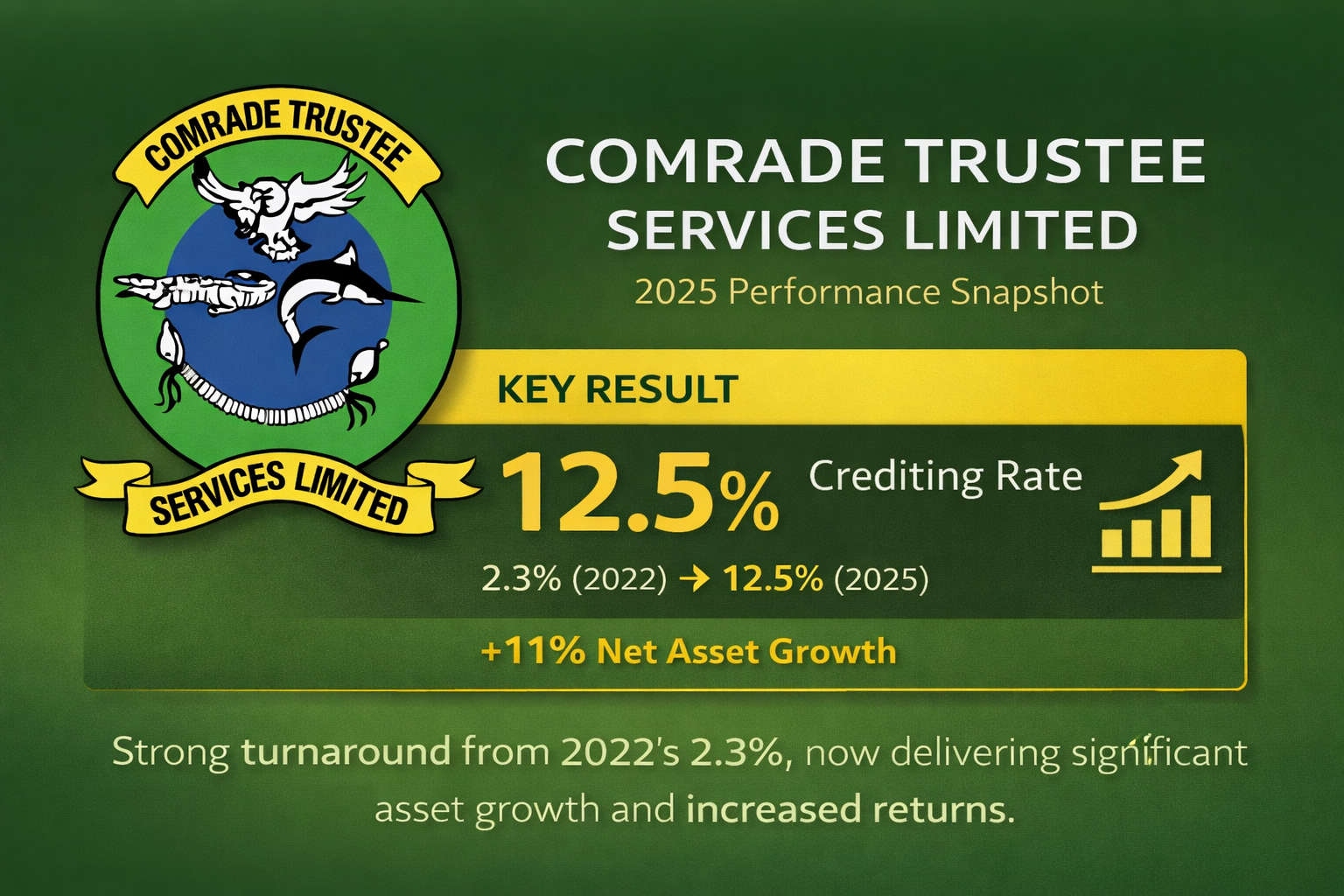
For Chief Executive Officer Charlie Gilichibi, the increase in crediting rates—from 2.3 percent in 2022 to 12.5 percent in 2025—points to a deliberate turnaround following a period of financial pressure.
“Post-2022, CTSL has moved from a defensive, capital preservation phase into a position of strength, stability, and sustainable growth. This has been underpinned by improved liquidity, stronger earnings, and a more disciplined balance sheet.”
The result places CTSL within a wider pattern of strong performance across Papua New Guinea’s superannuation sector.
Nambawan Super, a fund with the largest investment holdings in the country, and Nasfund have both reported solid returns for 2025, reflecting favourable market conditions and improved fund management.
Nambawan Super delivered a 12 percent crediting rate, with net assets reaching K13 billion, alongside K933 million in contributions and K716 million in benefits paid.
Nasfund reported a 13 percent crediting rate, supported by approximately K1.08 billion in net profit after tax, lifting its net asset value to around K9.45 billion and crediting roughly K1.1 billion to members.
Much of this performance—across all three funds—has been supported by strong equity markets, particularly consistent dividend flows and capital gains from Bank South Pacific and other blue-chip investments.
CTSL’s recovery, however, is distinct because of its starting point.
When Gilichibi took over in 2020, the fund was operating under liquidity constraints that limited its ability to invest and meet obligations. The strategy since then has focused on rebuilding the balance sheet before pursuing higher returns.
“We have taken a measured and disciplined approach to rebuilding the balance sheet, ensuring returns to members are delivered without compromising long-term sustainability. That has meant making difficult but necessary decisions to clean up the portfolio.”
Those decisions included recognising impairments and exiting underperforming investments—equivalent to about six percent of net asset value across 2024 and 2025. While this weighed on short-term performance, it strengthened the fund’s financial position and created room to reinvest in higher-quality assets.
Today, CTSL’s portfolio is anchored by income-generating investments, with around 88 percent allocated to domestic equities, including exposure to BSP, alongside 12% of the portfolio invested offshore.
Unlike traditional financial institutions, CTSL’s performance is driven primarily by investment income rather than lending activity. Strong financial returns, combined with tighter cost management, have underpinned the improved results.
The question now is whether this level of return can be sustained.
While the 12.5 percent crediting rate places CTSL competitively alongside its larger peers, Gilichibi is cautious about framing it as a new benchmark. The emphasis, he says, is on consistency rather than peak performance.
“We are positioning the Fund to deliver consistent, sustainable returns over the long term, rather than short-term performance spikes. Our priority is resilience across different market conditions.”
For members, the immediate impact is clear. A 12.5 percent crediting rate, alongside an 11 percent increase in net asset value, signals that retirement savings are growing on a more stable and sustainable base.
Looking ahead, CTSL’s priorities include strengthening governance and risk management, expanding its membership base outside of the Papua New Guinea Defence Force—and increasing international exposure from 12.5 percent to around 20 percent to improve diversification.
The trajectory reflects a broader shift across Papua New Guinea’s superannuation sector: one defined not only by stronger returns, but by improved governance, disciplined investment, and a more structured approach to long-term growth.
For CTSL, the recovery phase appears complete. The next challenge will be maintaining that discipline in a stronger, and potentially more uncertain, global market environment.