
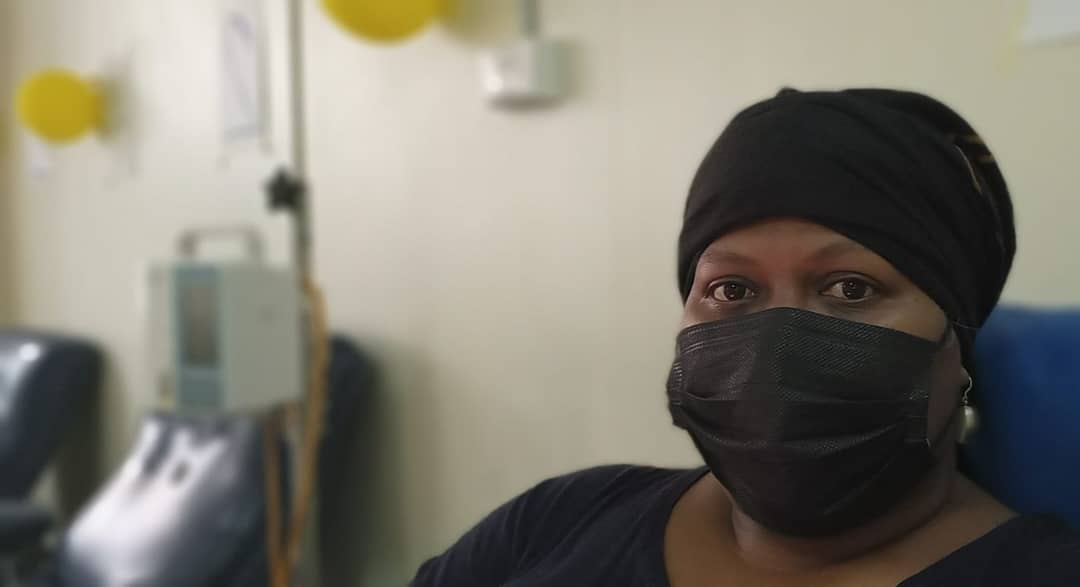
Part 3: Cancer affects everyone
This is the final part of a three part special report on the plight of a PNG woman living with cancer and having to contend with a dysfunctional health system and high costs of drugs in Papua New Guinea.
Cancer affects family members as much as it does the patient, and as much as possible, Bertha did not want her family’s focus to shift solely to her when she was diagnosed.
When she first received the results of her biopsy, she sat her older children down to explain what was happening. She wanted her children to continue being children, to enjoy their childhood without focusing all their attention on her illness.
It was a particularly tough time for her family, especially as they were still adjusting to their father not being around following a separation in 2019.
“It’s been very tough on them, especially without having their father around as well… because he left us in 2019, and then in 2020 we were all just getting used to not having him around. I was trying to get the kids to go through that process when all of a sudden we were all fine, and then in 2021 we got knocked with this.”
Bertha had to watch her children grow up quickly without her, as she spent extended periods away undergoing treatment. Her eldest daughter, now 21, has decided to stay home to help care for her younger siblings while their mother goes through treatment. Throughout this process, the children have been encouraged to speak openly about their feelings as the family navigates their mother’s illness together.
“I try as much as possible not to show any type of negative emotion in front of them. But it’s also good to cry and have everybody express how they feel and what not. So yeah, it’s been very challenging.”
The cancer health care experience
It has been a journey of discovery for Bertha, who has spent the past two years walking hospital corridors as a patient.
One of the first things she noticed at Port Moresby General Hospital was that cancer services were free. While she was relieved by this, the reality of Papua New Guinea’s strained health system soon became apparent.
Her experience has been marked by familiar challenges in the country’s health sector: bed shortages, expired and unavailable drugs, broken-down machines, and the high cost of specialist treatment that many Papua New Guineans simply cannot afford.
“If someone is missing a particular drug, you either wait until it becomes available at the hospital or you have to go and pay for it. And then sometimes, even at the pharmacies, it’s not always available.”
What makes the situation worse is when essential drugs are unavailable and treatment has to be put on hold as a result.
Bertha has expressed frustration that despite cancer being one of the country’s major killer diseases, with increasing numbers of diagnoses each year, it is still not treated as a national priority.
Through her journey, she has crossed paths with other women diagnosed with breast cancer, whom she refers to as her “breast mates.” Sadly, some of the women she shared this journey with have since lost their battle.
“It’s hard when you know patients are in the early stages and it can be beaten, but without the treatment they need, it prolongs the illness. The disease progresses, and they reach a stage where it can’t be treated.”
Witnessing others pass away from the same condition has been deeply difficult. Bertha describes a sense of guilt that sometimes arises, knowing that her breast mates were on the same treatment and taking the same medication, yet did not survive.
Much of this, she says, comes down to delayed referrals and the lack of facilities and equipment needed for effective cancer treatment in Papua New Guinea.
“We still need more. We need facilities that can conduct more testing. Some of my tests had to be sent to Australia, like the PET scan. I need that scan to see if there’s any spread to tissues. I can choose to remain here, but I don’t know what’s happening in my body.”
“Without all these facilities, we’re losing people. My friends—we’re at a stage where we can be treated, but because we don’t have these things, we lose them.”
READ MORE:
https://lekmak.com/2023/06/21/special-report-berthas-battle-with-breast-cancer-part-1/
https://lekmak.com/2023/06/22/special-report-berthas-battle-with-breast-cancer-part-2/
Therapy still unavailable in Papua New Guinea
Over recent months and years, an overwhelming number of medical appeals have circulated on social media, seeking financial support for cancer patients.
These appeals often involve fundraising for sisters, mothers, daughters, and friends who require radiation therapy—treatment that must be carried out overseas because it is not available in Papua New Guinea.
In 2016, the Lae media fraternity reported extensively on the plight of cancer patients in Lae, where the absence of a radiation oncologist and a non-functioning cobalt machine left patients without critical care. The cost of drugs was high, and the fight to survive was expensive.
In 2019, the National Parliament unanimously passed the Radiation Safety and Control Act 2018. In his speech, then Health Minister Dr Puka Temu said the law would allow the use of high-radiation sources for cancer treatment.
One of the reasons radiation therapy could not be performed in the country was the absence of laws governing the use of radioactive material.
Radio New Zealand quoted Dr Temu as saying:
“Today is a historic moment for parliament. As all of us are aware, the rise of cancer in the country and the suffering it has posed to many of our citizens demands that the country provide the right treatment.”
The National also quoted Dr Temu, saying:
“Because of the lack of a regulatory framework, Cobalt-60—which is a radioactive source necessary for cancer treatment—could not be procured.”
“The Angau Cancer Unit had been using Cobalt-60 for radiotherapy treatment, but after it became a threat to other countries’ domestic security, laws around its procurement became tougher. That is why it took a long time, as we had to comply with international standards.”
While this legislation provided hope, several other processes were still required.
Earlier this year, the Post-Courier reported gynaecologist and Deputy Chairman of the National Health Board, Dr Mathias Sapuri, as saying Papua New Guinea registers approximately 25,000 new cancer cases each year.
He said the fatality rate remains high due to poor screening and limited health care services.
“We currently have ineffective screening programs, no radiotherapy, minimal availability of chemotherapy drugs, and no cancer prevention vaccination program.”
Dr Sapuri added that less than 3 percent of health services in PNG are dedicated to cancer care, compared to 15 percent in other developing nations and up to 80 percent in advanced countries.
These issues reflect Bertha’s experience, and that of many other cancer patients across the country.
In an effort to address cancer treatment challenges, Kumul Petroleum Holdings Limited signed a K10 million memorandum of understanding (MOU) for the construction of modern cancer facilities at Port Moresby General Hospital, and a K15 million MOU with the Morobe Provincial Health Authority for the Angau Cancer Unit. This enabled the recruitment of a medical oncologist and repairs to the cobalt unit.
Nearly five years after the Radiation Safety and Control Act 2018 was passed, several requirements still need to be met before radiation therapy can be provided locally.
According to a social media post by Kumul Petroleum, the organisation has paid fees to register Papua New Guinea with the International Atomic Energy Agency (IAEA). The Morobe PHA, National Department of Health, and the National Institute of Standards and Industrial Technology are working to meet IAEA standards.
“As soon as we meet all requirements, the IAEA will grant approval to bring in the new isotope for the cobalt unit this year. Radiation treatment will be available to Papua New Guineans once all requirements are met,” the post stated on 6 February.
In the absence of radiation therapy locally, Bertha and many other cancer patients must travel overseas to complete their treatment—a costly process that many cannot afford.
“Radiation therapy is one of the most common and effective forms of cancer treatment. It’s hard when patients are in the early stages and should have a good chance of beating it, but they can’t because most patients aren’t able to afford overseas treatment. The absence of this treatment in the country means people will die, and that’s the sad reality.”
How soon radiation therapy will be available in Papua New Guinea remains an unanswered question.

Yes, My husband is diagnosed with Premolar cancer stage 4b and we are struggling to get better treatment and as time passed his condition is getting worse. We need help
I just finished reading all three parts to Bertha’s battle with cancer. I knew the story was going to paint the picture it did and I am grateful you have told it. These frustrations are felt by hundreds of patients and families in PNG. The fact that only 3% of PNGs health services focus on cancer compared to 15% in other developing nations really stood out to me. Why is this so?
I have recently buried my youngest brother who was taken by cancer at the age of 47, but he was living in Australia and went through the Qld Health system. Yes, he passed away, but their treatment extended his life almost three years longer than was expected and every possible treatment and drug was readily available and delivered with the stroke of a pen or the click of a mouse.
The contrast in his experience vs the experience of Bertha and countless others in PNG could not be more stark.
It stung to see the run-around Bertha was given. The fact that she missed a vital window after her mastectomy to wipe that cancer out for good. All the conflicting advice and mis-advice. It’s not just the lack of drugs and the machines, it’s the lack of knowledge and cohesiveness from medical staff too. It’s just too heartbreaking to even think about the number of my own family members I’ve lost through mis-diagnosis and wrong treatment in PNGs health system.
What’s also hard to swallow is that PNG is a resource rich nation. We like to boast about our natural resources and other Pacific nations look at us with envy of our God-given resources, but somehow this wealth does not reach where it should, to help people like Bertha.
Over the past decade I have not seen any glimmer of hope for this happening and I wonder whether that day will ever come for PNG.