
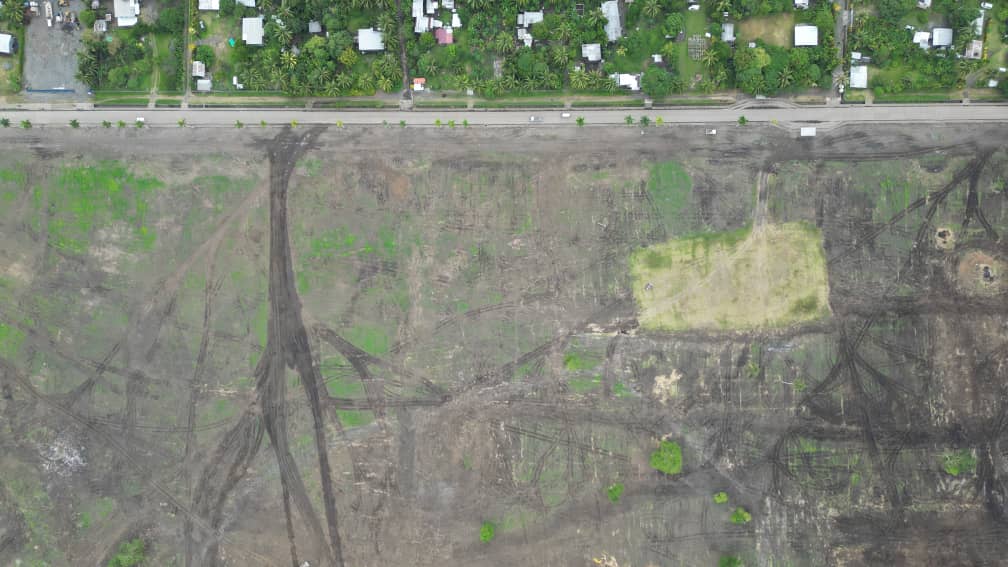
For nearly half a century, Lae has expanded without expanding properly. The city has grown in population, in economic significance and in pressure — but not in planned residential space. Between the University of Technology and Igam Barracks, that pattern is now being challenged.
The Igam land development — led by Toea Homes Limited and supported by Comrade Trustees Services Limited (CTSL) — is not simply another subdivision. It is a structural intervention in one of Papua New Guinea’s most persistent economic bottlenecks: access to serviced, bankable land.
At full scale, the development will deliver around 1,300 allotments, alongside commercial space, public amenities and green areas. But the significance of Igam goes beyond housing supply. It touches superannuation reform, banking liquidity, SME growth, provincial urbanisation and GDP contribution.
For Chief Executive Officer of CTSL, Charlie Gilichibi, it is about the economic implications.
“When you release serviced land at scale, you unlock far more than titles. You unlock bank financing, construction jobs, supplier networks and small businesses that depend on that activity.”

That chain reaction matters. Each allotment represents a mortgage application. Each mortgage triggers construction. Each build engages hardware suppliers, transport operators, tradespeople and local contractors. The first round of financing circulates through the economy multiple times.
Estimates suggest that over the next decade, developments linked to CTSL in Port Moresby and Lae could contribute between K1–2 billion in economic activity. In national terms, that is measurable GDP impact. In provincial terms, it is transformative.
Lae’s strategic importance strengthens the argument. As the industrial gateway to the Highlands and Islands, Lae carries freight, trade and manufacturing weight that Port Moresby does not. Yet for decades, residential supply has lagged behind its economic role.
Toea Homes Chairman Charles Lee argues that development in Lae is overdue.
“Lae is the commercial spine of the country outside Port Moresby. If you want balanced national growth, you have to invest where industry and trade are already moving.”
Balanced growth is a phrase often used loosely. In this case, it has tangible meaning. For years, major residential investment has been concentrated in the capital. Igam signals that structured development can occur outside the National Capital District — and succeed.
But the importance of Igam extends further. It reflects a recovery story inside CTSL itself.
The project emerged from a period of financial strain. Tens of millions of kina had been committed under earlier arrangements. Regulatory intervention followed. A shift in strategy reduced risk exposure — focusing on servicing land rather than building houses outright.
Today, the fund reports stronger cash flow and liquidity. Igam is being developed in stages, designed to be self-funding.
Gilichibi views this as a governance lesson as much as a property venture.
“We had to restore discipline before we could restore confidence. Strong internal controls and staged development give members assurance that projects are sustainable.”
That reassurance is critical for superannuation contributors. For many public servants and Defence Force members, retirement security remains closely tied to land ownership. Too often, contributors exit formal employment without a permanent home and end up in informal settlements.
Affordable, serviced land with proper title changes that trajectory. And the Igam model includes discounted allotments for members — effectively building equity into the purchase from day one.
Yet housing affordability cannot be solved by developers alone. One of the recurring themes in discussions around Igam is the role of government infrastructure.
In many jurisdictions, trunk infrastructure — main roads, water, sewerage and power — is funded publicly. In PNG, those costs frequently fall on developers, pushing land prices higher.
Charles Lee makes that point clearly.
“If government carries its share of infrastructure costs, developers can pass real savings to buyers. That is how you lower entry barriers without compromising standards.”
Lae City Authority’s involvement in the Igam project demonstrates a working example of that partnership. By taking responsibility for elements of trunk infrastructure and public space planning, the cost burden on the developer is reduced — and prices become more competitive.
The broader implication is significant. Papua New Guinea’s land tenure structure remains one of its most complex economic constraints. Only a small percentage of the total landmass is under State Lease. The rest is customary. That creates pressure on the limited supply of bankable land.
Unlocking more land — through proper registration, titling and partnership models — is central to future growth. Igam shows how that can happen within existing legal frameworks.
It also signals something else: confidence.
Large-scale residential projects require long-term outlooks. They require faith in market demand, regulatory stability and economic resilience. Launching a 1,300-allotment suburb is not a short-term gesture; it is a decade-long commitment.
For Lae, it redefines the city’s expansion corridor. For Morobe Province, it anchors future commercial spillover. For PNG’s economy, it represents the kind of productive investment that multiplies rather than merely circulates money.
There is also a psychological shift. Planned suburbs with parks, schools and commercial precincts change expectations about urban living. They set new benchmarks for what provincial development can look like.
Igam will not, by itself, solve PNG’s housing shortage. Nor will it eliminate affordability pressures. But it establishes a replicable framework: regulated superannuation capital, disciplined governance, government partnership and staged delivery.
If Mount Hagen, Kokopo, Madang or Kimbe were to replicate similar models — releasing 1,500 to 2,000 allotments each with proper infrastructure support — the cumulative impact would be substantial. Employment would rise. SME ecosystems would expand. Superannuation funds would have viable domestic investment outlets.
In that sense, Igam is not only a housing project. It is a policy experiment in real time.
It tests whether public-private collaboration can translate into measurable economic stimulus outside the capital. It tests whether superannuation funds can drive nation-building while protecting member returns. And it tests whether provincial cities can plan forward instead of expanding informally.
The success of Igam will ultimately be measured not just in titles issued, but in lives stabilised and economic activity generated.